

Quality Facing Brickwork on Large Housing Developments: What Good Looks Like
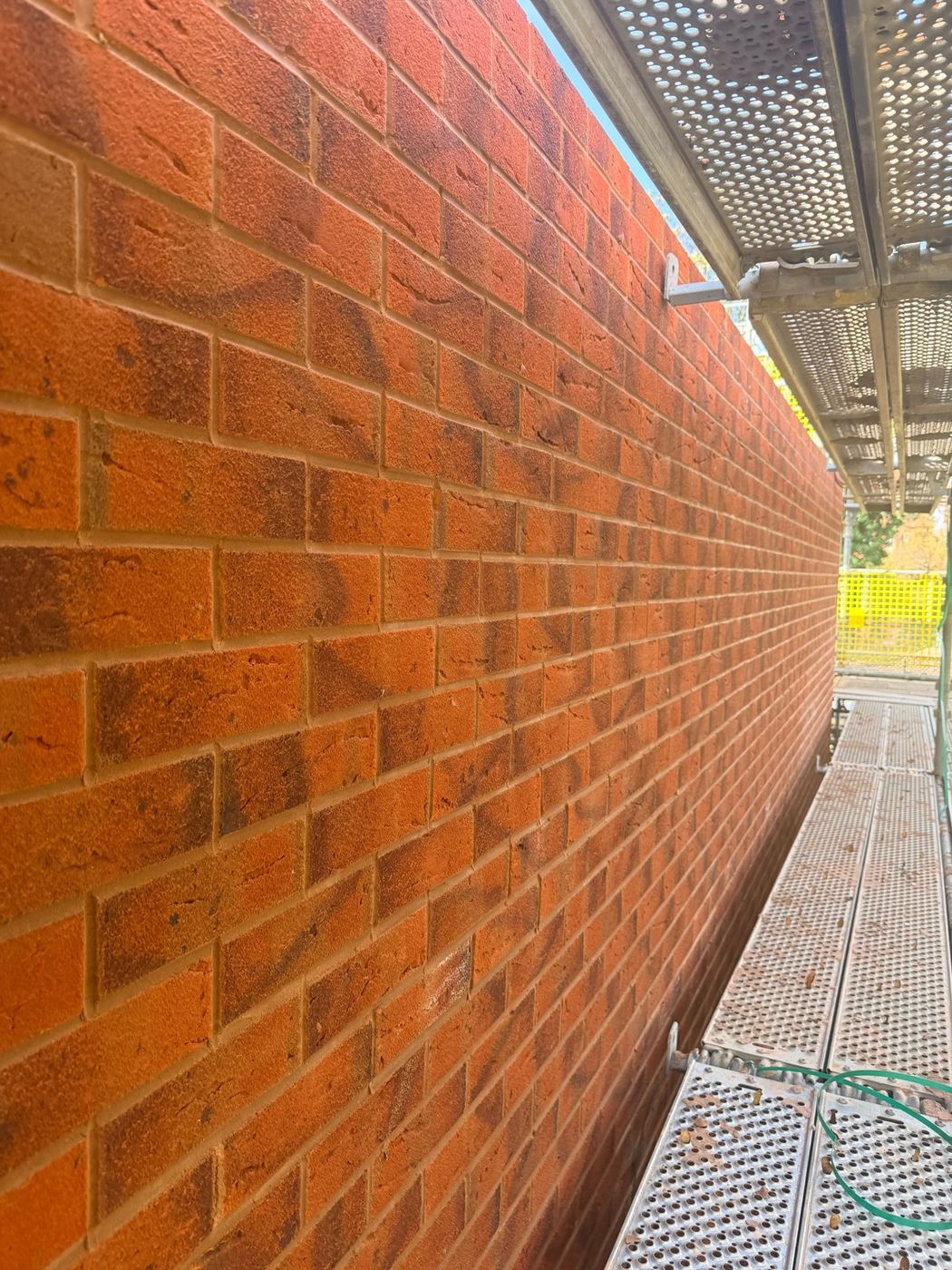
Some really high-quality facing brickwork is going up at one of our large developments. The photo shows a long elevation taken from the scaffold: straight, consistent courses and clean joints the full length of the wall. That is the standard our gangs work to on every plot, and it is what a housebuilder or main contractor should expect from a bricklaying contractor on a large housing development.
On a single house, good brickwork is mostly about the bricklayer. On a large development, it is about keeping that standard the same from the first plot to the last, across different gangs, brick deliveries and weather. Here is what quality facing brickwork looks like in practice. It is general guidance, not a replacement for the specification, the housebuilder’s standard details or the warranty provider’s requirements.
Gauge: courses that line up
Gauge is the vertical spacing of the courses. In the UK, standard bricks with 10mm joints usually work to four courses per 300mm. Holding gauge matters because sills, lintels, window heads and eaves are designed to line up with the coursing. If gauge drifts, joints get thick or thin to catch up, and the error shows at every opening. Gauge rods or marked profiles should be set out from DPC level and checked as the work goes up, so the same house type builds the same way on every plot.
Line and level: straight, flat and plumb
Line is how straight the wall runs along its length, and level is how true each course is. On a long elevation like the one in the photo, even a small wander in line shows up when you look along the wall. Good practice is to work to corner profiles and a taut line, check level regularly, and keep each lift plumb with the one below. Walls should also be checked for flatness, because bulges and hollows catch the light, especially on long gable and side elevations.
Clean joints and a consistent finish
Joints frame every brick, so they affect the look of the wall as much as the brick itself. Clean joints mean:
- Consistent joint widths, horizontally and vertically, with perpends that stay plumb.
- The same joint profile, such as bucket handle or weatherstruck, agreed on the sample panel and used by every gang.
- Jointing at the right time, once the mortar has stiffened enough, so the finish and colour stay even.
- A clean face, with smears brushed off at the right time and no mortar staining. Our guide to mortar staining and droppings in cavity walls explains the causes and controls.
- Consistent mortar, with the same mix, colour and water content across the site.
Consistency across plots and phases
The real test on a large development is whether plots look the same. Bricks arrive in different batches, gangs move between plots, and later phases have to match homes that are already occupied. Contractors manage this by blending bricks from several packs as they lay, working every plot to the agreed sample panel, and keeping the same supervisor on site where possible. Recording how standard details are built, such as reveals, sills, soldier courses and corbels, also helps later phases match. Setting out and gauge should be checked on every plot, not just the first of each house type. Our page on new-build housing brickwork explains how we handle this.
Plots handed over ready for inspection
Good-looking brickwork is only half the job. Before a plot moves on to the roofer and scaffold strike, it should be ready for the site manager and the NHBC or LABC inspector. That means:
- Wall ties at the specified spacing, with extra ties at openings and movement joints.
- Cavity trays, stop ends and weep vents in place over openings and at abutments.
- Cavities and ties clear of mortar droppings, and insulation fixed correctly.
- Movement joints positioned to the design and kept clean.
- Quality checks recorded plot by plot, with snags closed out promptly.
When those records are shared as the work goes up, the warranty inspection is a check rather than a hunt, and plots move on without delay.
How we work at Vanguard Masonry
Vanguard Masonry is a bricklaying contractor, established in 2018, with 100 bricklayers working on housing, apartment and commercial schemes across the Midlands and the North West. We hold Constructionline Gold and CHAS Advanced. Each package has a named supervisor, daily site logs and quality checks recorded plot by plot. Read more about our brickwork services, see the areas we cover, or find out how we work as a bricklaying contractor in Stafford, a bricklaying contractor in Derby or a bricklaying contractor in Nottingham.
Have a housing scheme out to tender? Send us the site layout, house types and programme. Call 01785 526030 or email estimates@vanguardmasonry.co.uk, or use our contact page.